Understanding a Social Security Disability Hearing
If your Social Security Disability (SSDI) or Supplemental Security Income (SSI) claim has been denied at both the initial application and reconsideration levels, your next step is usually a hearing before an Administrative Law Judge (ALJ).
For many people, this is the most important stage of the disability process. It is also where many deserving applicants are finally approved for benefits.
While the thought of appearing before a judge can be intimidating, a disability hearing is much less formal than most people imagine. Hearings are typically conducted by video, telephone, or in person, and they are designed to give the judge a better understanding of how your medical conditions affect your ability to work.

Preparing for Your Hearing
Winning a disability hearing begins long before the hearing date.
Months in advance, we obtain and review your medical records from your physicians, hospitals, therapists, and other treatment providers. We make sure the evidence is complete, organized, and submitted to the Social Security Administration within the required deadlines.
When appropriate, we also work with your treating providers to obtain medical opinions describing your functional limitations. These opinions often address issues such as:
· Your ability to sit, stand, and walk.
· Lifting and carrying restrictions.
· Use of your hands and arms.
· Concentration and mental functioning.
· Attendance and reliability in a work environment.
· The expected duration of your limitations.
We carefully review all of the medical evidence to determine the strongest legal theory for your case—whether that involves meeting a Listing, equaling a Listing, or demonstrating that your physical or mental limitations prevent you from performing substantial work.
When appropriate, we also prepare a written brief for the judge summarizing the medical evidence, applicable law, and why you qualify for disability benefits before the hearing even begins.
Preparing You
One of the most important parts of our job is preparing you for the hearing.
Before the hearing, we meet with you to discuss the process, review the important issues in your case, and explain the types of questions you are likely to be asked. Our goal is not to give you scripted answers, but to help you feel comfortable explaining how your medical conditions affect your daily life and ability to work.
Knowing what to expect often helps reduce anxiety and allows you to focus on answering the judge’s questions honestly and completely.
What Happens During the Hearing?
The Administrative Law Judge controls the hearing and places everyone under oath.
The judge will ask questions about topics such as:
· Your medical conditions.
· Your symptoms and treatment.
· Your work history.
· Your education and training.
· Your daily activities.
· How your conditions limit your ability to work.
Your representative will also have the opportunity to ask follow-up questions to clarify important facts and ensure the judge understands the full impact of your disabilities.
The Vocational Expert
Many disability hearings include testimony from a Vocational Expert (VE).
The vocational expert is an independent specialist who provides testimony about the physical and mental demands of jobs and whether someone with your limitations could perform work that exists in significant numbers in the national economy.
The judge presents hypothetical questions to the expert based on different levels of functional limitations.
Your representative has the opportunity to question the vocational expert, identify inconsistencies, and demonstrate why the evidence supports a finding of disability.
Medical Experts
In some cases, the SSA asks an independent medical expert to testify.
Medical experts are used less frequently than vocational experts, but they may be called when a case involves complex medical issues or the judge needs assistance interpreting the medical evidence.
If a medical expert testifies, your representative may question the expert and address any opinions that are inconsistent with your treating medical records.
Consultative Examinations
Sometimes the SSA needs additional medical information before making a decision.
In those situations, you may be scheduled for a Consultative Examination (CE) with an independent physician or psychologist selected by the SSA.
It is important to attend these appointments. The examination report becomes part of the evidence the judge considers when deciding your case.
Additional Evidence
Occasionally, the judge may determine that additional medical records or other evidence are needed before a decision can be issued.
If that happens, the record may remain open for a limited period while the additional evidence is obtained. Our goal is always to gather and submit complete medical evidence before the hearing to avoid unnecessary delays whenever possible.
When Will I Receive a Decision?
Most judges do not announce their decision during the hearing.
Instead, they review all of the evidence after the hearing and issue a written decision explaining the reasons for approving or denying the claim.
The amount of time varies depending on the hearing office and the complexity of the case, but many decisions are issued within several weeks to a few months.
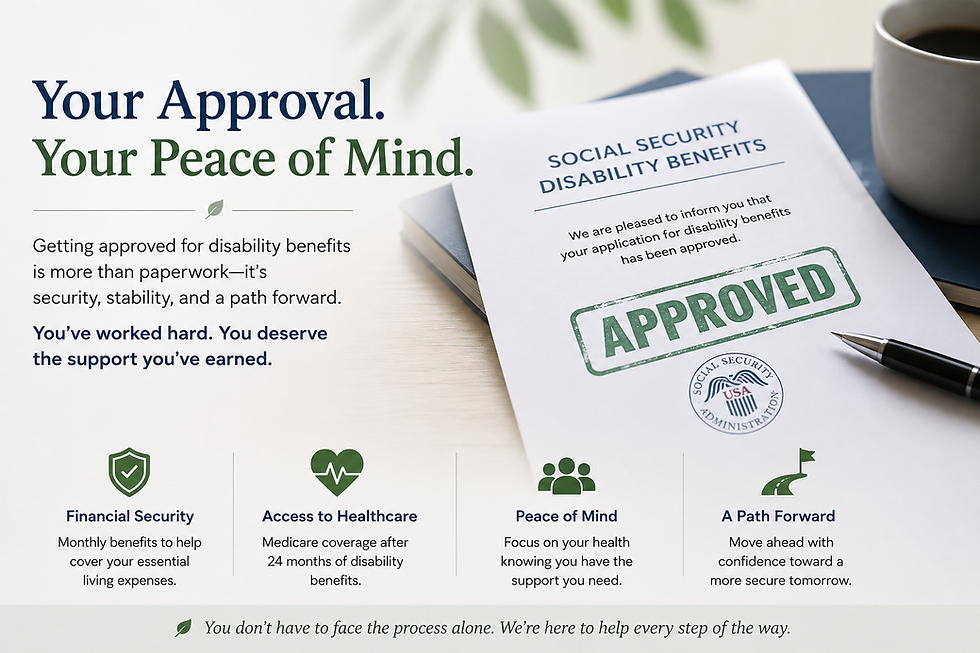
If your claim is approved, the SSA will calculate your past-due benefits and ongoing monthly payments. We review the decision and award information with you to help ensure everything is accurate and to answer any questions you may have.
If the judge denies your claim, we will discuss your options, including whether an appeal to the Appeals Council is appropriate.
Experience Matters
A disability hearing is often your best opportunity to present your case directly to the judge. Thorough preparation, complete medical evidence, and experienced representation can make a significant difference.
Our office prepares every case as though it will proceed to hearing. If your case reaches that stage, you can be confident that we will stand beside you, present the strongest evidence available, and advocate for the benefits you deserve.
Disclaimer: The information provided in this article is for general educational and informational purposes only and is not intended as legal advice, medical advice, or a substitute for professional guidance. Reading this article does not create a representative-client relationship. Social Security laws, regulations, policies, and procedures may change over time, and the information presented may not reflect the most current legal or administrative developments. Every case is unique. If you have questions about your specific situation, you should consult with a qualified Social Security disability representative or attorney before making any decisions.