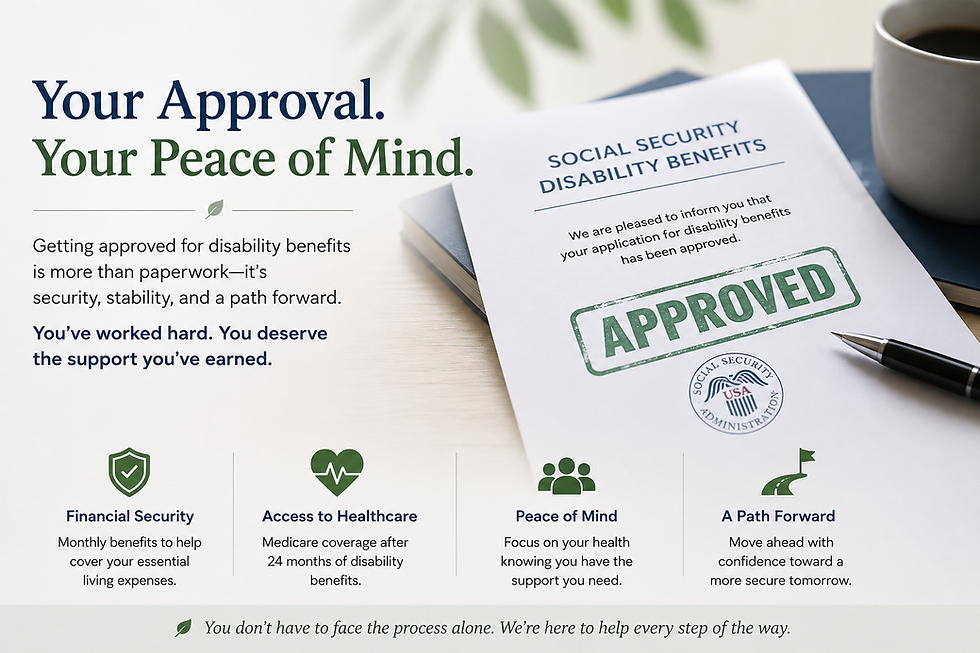
Health Insurance for the Disabled
“If I’m approved, will I finally have health insurance?”
The answer depends on which disability program you qualify for.
People approved for Social Security Disability Insurance (SSDI) and those approved for Supplemental Security Income (SSI) generally receive different types of healthcare coverage.
Let’s take a look at how each program works.

If You’re Approved for SSDI
If you’re approved for Social Security Disability Insurance (SSDI), you will generally become eligible for Medicare, the federal health insurance program.
For most people, Medicare begins after the required waiting period established by federal law.
However, the waiting period doesn’t always begin on the day you’re approved. Instead, it is based on Social Security’s determination of when your cash disability benefits begin. Because every disability claim is different, the date Medicare coverage starts can vary from person to person.
There are also important exceptions. Individuals with ALS (Lou Gehrig’s disease) and certain people with End-Stage Renal Disease (ESRD) may qualify for Medicare much sooner under federal law.
Understanding Medicare
Medicare has several different parts, each covering different healthcare services.
Medicare Part A
Part A generally covers:
· Hospital stays.
· Skilled nursing facility care (when eligibility requirements are met).
· Certain home health services.
· Hospice care.
Most people who qualify for SSDI receive Part A without paying a monthly premium because they have worked and paid Medicare taxes.
Medicare Part B
Part B covers many outpatient medical services, including:
· Doctor visits.
· Specialist appointments.
· Laboratory testing.
· Diagnostic imaging.
· Durable medical equipment.
· Preventive services.
Unlike Part A, Part B generally requires a monthly premium. Many people choose to enroll because it provides important medical coverage outside of the hospital.
Medicare Part D
Part D helps pay for prescription medications.
These plans are offered through private insurance companies approved by Medicare, and costs and covered medications vary by plan.
Medicare Advantage (Part C)
Some individuals choose to receive their Medicare benefits through a Medicare Advantage (Part C) plan instead of Original Medicare.
These plans are offered by private insurance companies approved by Medicare and often combine hospital, medical, and prescription drug coverage into one plan. Some also provide additional benefits, such as dental, vision, or hearing coverage.
Because every plan is different, it’s important to compare available options before enrolling.
If You’re Approved for SSI
If you’re approved for Supplemental Security Income (SSI), your healthcare coverage is different.
SSI recipients generally become eligible for Medi-Cal in California, which is the state’s Medicaid program.
Medi-Cal provides comprehensive healthcare coverage for many medical services, including:
· Doctor visits.
· Hospital care.
· Mental health services.
· Prescription medications.
· Laboratory testing.
· Many other medically necessary services.
For many Californians, Medi-Cal coverage begins automatically when they qualify for SSI, although eligibility and enrollment procedures can vary depending on individual circumstances.
Can You Have Both Medicare and Medi-Cal?
Yes.
Some individuals qualify for both Medicare and Medi-Cal.
This is sometimes called being “dually eligible.”
When someone qualifies for both programs, Medicare is generally the primary insurance, while Medi-Cal may help pay certain deductibles, copayments, premiums, and other covered expenses.
Having both types of coverage can significantly reduce out-of-pocket healthcare costs.
Choosing the Right Medicare Coverage
Once you become eligible for Medicare, you’ll have several coverage options.
Choosing the right combination of Medicare, Medicare Advantage, prescription drug coverage, and any supplemental insurance depends on your health needs, medications, doctors, and budget.
Because these decisions can affect both your healthcare and your finances, it’s important to carefully review your options before enrolling.
We’re Here to Help
Understanding disability benefits is challenging enough without also trying to navigate Medicare and Medi-Cal.
As a licensed insurance broker, I also help clients understand how Medicare, Medicare Advantage, prescription drug plans, Medi-Cal, and other insurance options work together so they can make informed decisions about their healthcare coverage.
If you have questions about disability benefits or the healthcare coverage that may be available to you, I’d be happy to answer your questions and help you understand your options.
Disclaimer: The information provided in this article is for general educational and informational purposes only and is not intended as legal advice, medical advice, or a substitute for professional guidance. Reading this article does not create a representative-client relationship. Social Security laws, regulations, policies, and procedures may change over time, and the information presented may not reflect the most current legal or administrative developments. Every case is unique. If you have questions about your specific situation, you should consult with a qualified Social Security disability representative or attorney before making any decisions.